10 Garden Window Ideas: Bright & Functional Planting Displays for Every Home
If you’ve ever stared at a plain kitchen window wishing there was something more interesting to look at, a garden window might be exactly what your home needs. These box-style windows extend outward from the wall, catch light on three sides, and create the perfect little sanctuary for herbs, trailing plants, succulents, and flowers. Whether you rent or own, whether your space is small or large, there’s a garden window idea here that will work for you.
What Exactly Is a Garden Window?
Before we get into the ideas, a quick note for anyone who’s new to this concept.
A garden window is a box-shaped window that protrudes outward from the exterior wall of a house, usually by about 12–16 inches. Unlike a standard flat window, it has glass on three sides and often a glass or solid roof panel on top. This design catches light from multiple angles, which is why it’s so good for growing plants — especially in rooms like the kitchen where a south or east-facing window might otherwise give you just a few hours of direct sun.
They’re most commonly installed above kitchen sinks, but they work beautifully in bathrooms, dining rooms, and living spaces too.
📌 [Image suggestion: A diagram-style or real photo showing the structure of a garden window — the box protrusion, three glass sides, and shelf inside]
Why Garden Windows Are Having a Major Moment on Pinterest
If you’ve spent any time on Pinterest in the last year, you’ve probably saved at least one photo of a dreamy herb-filled kitchen window or a succulent display glowing in afternoon light.
Garden windows photograph incredibly well. The combination of natural light, greenery, and that warm glass-box glow creates exactly the kind of image that gets repinned thousands of times.
But beyond aesthetics, people are genuinely drawn to the functionality. A garden window gives you usable growing space inside your home — which matters when you’re cooking with fresh herbs, starting seeds in early spring, or simply trying to keep plants alive through a cold winter.
Now, onto the ideas.
1. The Classic Herb Kitchen Garden Window
This is the one that started the whole trend, and it’s still the most practical of all garden window ideas.
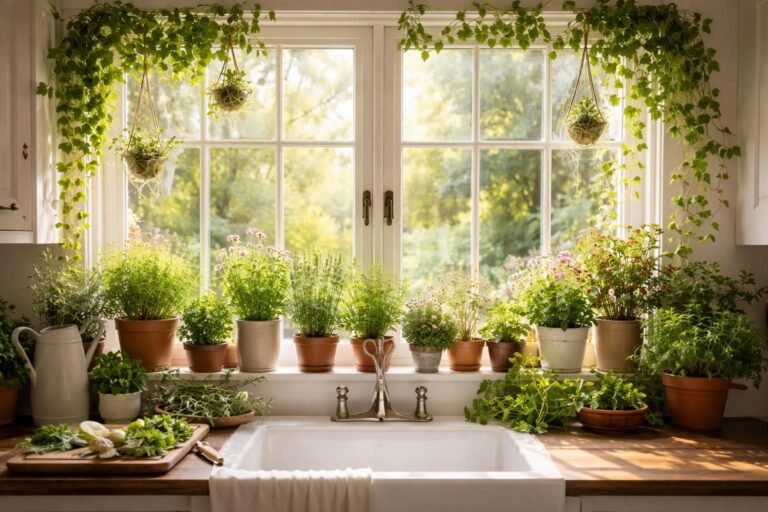
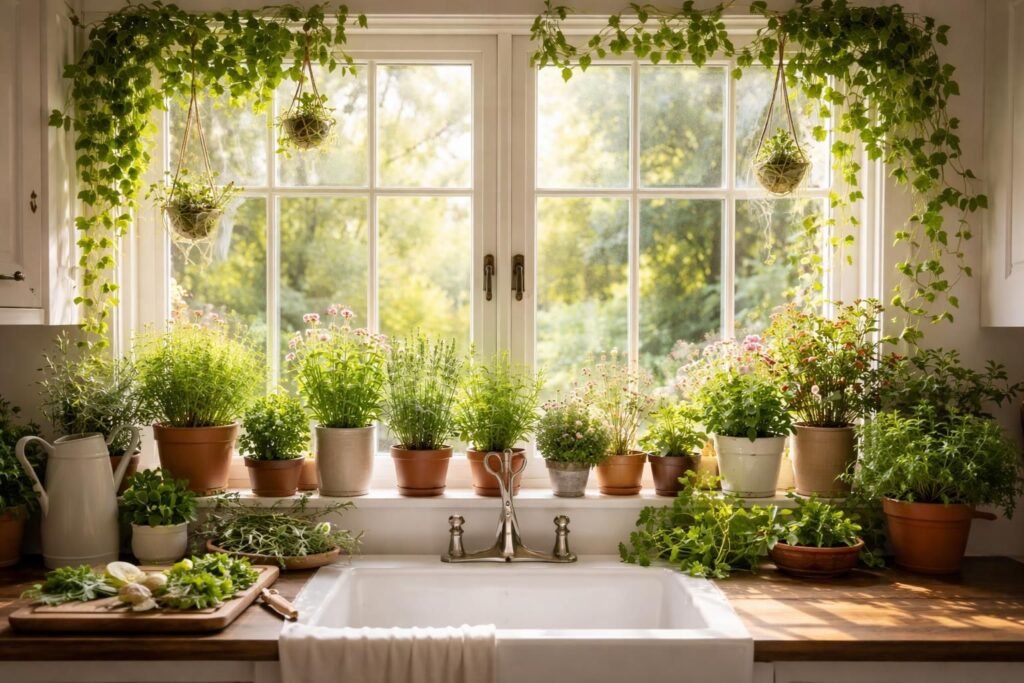
Fill your kitchen window box with a rotating selection of fresh herbs: basil, parsley, thyme, rosemary, mint (keep this one in its own pot — mint spreads aggressively), and cilantro. The herbs stay within arm’s reach while you cook, the window smells incredible, and the display looks genuinely lush without any special styling skill.
📌 [Image suggestion: A kitchen garden window above the sink filled with terracotta pots of fresh herbs — basil, rosemary, and thyme — warm natural light]
Tips for a kitchen herb garden window:
- Use individual terracotta pots rather than one long planter — you can swap out plants that are spent without disturbing the rest
- Keep herbs that need the most water (basil, cilantro) at the front where you’ll notice them daily
- Add a small tray or liner beneath the pots to catch drainage — your windowsill will thank you
- Replace herbs seasonally: cool-season herbs like cilantro and parsley in spring and fall, heat-lovers like basil in summer
Best herbs for a garden window: basil, thyme, rosemary, flat-leaf parsley, chives, oregano, mint (contained), lemon balm
2. A Succulent and Cactus Display Window
If you want the look without the daily watering, a succulent and cactus garden window is your answer.
Succulents and cacti genuinely thrive in the bright, warm conditions a south-facing garden window creates. They need minimal water, rarely drop leaves or make a mess, and their sculptural forms look beautiful grouped together. The variety available — from plump echeverias to tall columnar cacti to trailing string-of-pearls — means you can create a display that feels genuinely curated.
📌 [Image suggestion: A sunny garden window filled with an arrangement of mixed succulents and small cacti in white ceramic pots — warm afternoon light, clean and modern]
How to style a succulent garden window:
- Mix heights: tall cacti at the back, rosette-shaped echeverias and haworthias in the middle, trailing string-of-pearls or string-of-bananas at the front
- Use pots in a consistent material (all terracotta, or all white ceramic) for a cohesive look
- Add a layer of decorative sand or gravel on top of the soil — it finishes the display and improves drainage
- Water deeply but infrequently — once every 10–14 days in summer, even less in winter
Best plants for a succulent garden window: echeveria, haworthia, aloe, string-of-pearls, sedum, small columnar cacti, lithops (living stones)
3. The Trailing Vines and Greenery Window
Not every garden window needs to be about edibles or sculptural succulents. Sometimes the most beautiful display is simply lush, trailing greenery that spills over the shelves and hangs down in soft cascades.
Pothos, heartleaf philodendron, tradescantia, and string-of-pearls all do beautifully in the bright indirect light a garden window provides. Let them trail over the edges of the shelf, loop along the glass, and fill the frame with living texture.
This look works especially well in kitchens with white or light cabinetry — the green against white is classic and photographs brilliantly.
📌 [Image suggestion: A garden window with trailing pothos and philodendron spilling over the shelves in lush cascades — white kitchen background, morning light]
Best trailing plants for a garden window:
- Golden pothos — incredibly adaptable, trails long and fast
- Heartleaf philodendron — soft heart-shaped leaves, tolerates a range of light
- Tradescantia (spiderwort) — purple-and-green variegated leaves, very fast growing
- String-of-pearls — dramatic trailing look, needs bright light
- Creeping jenny — lime green, trails beautifully and grows quickly
4. A Cottage-Style Flower Window
Who says garden windows are only for plants you can eat or houseplants you can keep indefinitely?
A cottage-style garden window filled with small flowering plants brings color, scent, and an almost storybook quality to a kitchen or living room. Think: primulas in soft yellow and pink, African violets in deep purple, miniature roses, cyclamen in winter, and pansies in spring.
The key to making this look work is treating the window like you’d treat a flower arrangement — swap things out as they finish blooming, keep colors in the same family, and don’t be afraid to mix pot sizes and heights.
📌 [Image suggestion: A cottage-style garden window with a mix of small flowering plants — primulas, African violets, and miniature roses — in mismatched vintage-style pots]
Flowering plants that do well in garden windows:
- African violet — loves the warmth and humidity, blooms for months
- Miniature roses — need good light, reward you with long bloom periods
- Primula — great in cool seasons, vivid colors
- Cyclamen — autumn and winter bloomer, likes cool bright conditions
- Kalanchoe — succulent flowering plant, very low maintenance, blooms in many colors
5. The Kitchen Windowsill Vegetable Starter Garden
A garden window is a surprisingly good place to start vegetable seedlings in late winter or early spring before the outdoor growing season begins.
The glass-box structure creates a slightly warmer, more protected microclimate than a flat windowsill, which is perfect for germinating tomato seeds, starting pepper plants, or getting lettuces going a few weeks before your last frost date.
📌 [Image suggestion: Seed trays and small starter pots in a garden window, green seedlings emerging — a mix of tomato and herb starts in early spring light]
Once the seedlings are large enough to go outside, the window transitions back to a decorative herb or flowering display. It’s genuinely functional all year.
What to start from seed in a garden window:
- Tomatoes (start 6–8 weeks before last frost)
- Peppers (start 8–10 weeks before last frost — they need warmth)
- Basil (start 4–6 weeks before last frost)
- Lettuce and salad greens (these can go straight to outdoor containers once large enough)
- Marigolds and nasturtiums (for later transplanting to garden beds)
6. A Bathroom Garden Window for Spa Vibes
Garden windows aren’t just for kitchens.
A bathroom garden window — especially in a room with good natural light — creates an instant spa-like atmosphere. Fill it with plants that love humidity: ferns, orchids, peace lilies, and small tillandsias (air plants) that you can tuck into shells or driftwood.
📌 [Image suggestion: A bathroom garden window with ferns, an orchid, and air plants — soft natural light, white tiles, a sense of calm and luxury]
The steam from showers actually benefits many of these plants, which makes the bathroom one of the best microclimates in the house for tropical species that struggle in drier rooms.
Best plants for a bathroom garden window:
- Boston fern — loves humidity, lush and full
- Orchid (Phalaenopsis) — thrives in bright indirect light, blooms for months
- Peace lily — does well in lower light and humid conditions
- Tillandsia (air plants) — no soil needed, absorb moisture from the air
- Nerve plant (Fittonia) — small and colorful, loves warmth and humidity
7. A Minimalist Window Garden With White Pots and Greenery
Not everyone wants a maximalist plant-packed display. If your interior style is clean, modern, or Japandi-inspired, a minimalist garden window with a few carefully chosen plants in matching white or concrete pots might be exactly right.




The key here is restraint. Choose three to five plants maximum. Keep them in matching pots. Leave space between them. Let the negative space be part of the design.
📌 [Image suggestion: A minimalist garden window with three plants in matching white ceramic pots — a snake plant, a small fern, and a trailing pothos — clean, calm, modern]
Plants that suit a minimalist window garden:
- Snake plant — tall, architectural, almost sculptural
- ZZ plant — glossy dark leaves, very structured form
- A single trailing pothos in a clean white pot
- Haworthia or aloe — small, precise, beautiful
- One orchid stem in a sleek ceramic pot
8. A Seasonal Display Window That Changes Throughout the Year
One of the most practical garden window ideas is also one of the most overlooked: treating your window as a seasonal display that changes four times a year.
Spring brings flowering bulbs and fresh herb starts. Summer is for basil, trailing vines, and bright flowers. Autumn calls for ornamental kale, mini pumpkins mixed with late-season herbs, and warming amber tones. Winter is perfect for paperwhite narcissus, cyclamen, forced hyacinths, and evergreen sprigs.
📌 [Image suggestion: A four-season collage of the same garden window — spring flowers, summer herbs, autumn ornamentals, winter bulbs — all beautifully styled]
This approach keeps the display feeling fresh and gives you a reason to engage with the window all year. It also photographs beautifully for seasonal Pinterest content.
Seasonal planting ideas at a glance:
- Spring: tulip and hyacinth bulbs, herb starts, primulas
- Summer: basil, trailing vines, African violets, bright annuals
- Autumn: ornamental kale, mini squash, late herbs, chrysanthemums
- Winter: paperwhites, cyclamen, forced amaryllis, rosemary topiaries
9. A Functional Sprouting and Microgreens Window
If you’re into cooking or eating fresh, a garden window dedicated to sprouts and microgreens is one of the most practical setups imaginable.
Microgreens — the young seedlings of vegetables and herbs harvested at 1–3 inches tall — grow incredibly fast (usually ready in 7–14 days) and require almost no space or equipment. A few shallow trays in a bright garden window, some seed-starting mix, and a packet of seeds are all you need.
📌 [Image suggestion: Shallow trays of microgreens at various stages of growth in a bright garden window — sunflower shoots, radish microgreens, pea shoots — vibrant green]
Easy microgreens to grow in a garden window:
- Sunflower shoots — crunchy, nutty flavor, ready in about 10 days
- Pea shoots — sweet, tender, very fast
- Radish microgreens — slightly spicy, beautiful pink stems
- Broccoli microgreens — mild flavor, very nutritious
- Basil microgreens — intensely fragrant, gorgeous as a garnish
Keep a rotation going — start a new tray every five days or so and you’ll have a continuous harvest without ever running out.
10. A Bohemian Layered Plant Window
The last garden window idea is probably the most visually dramatic, and it’s the one that gets the most saves on Pinterest: the fully layered, boho-style display.
This is where you mix everything — trailing plants, small flowering plants, tiny cacti, air plants tucked into macramé hangers, dried botanicals propped between pots, a crystal or two catching the light. It’s maximalist, personal, and completely unique to whoever puts it together.
📌 [Image suggestion: A bohemian-style garden window with layered plants at multiple heights — macramé hangers, trailing vines, flowering plants, air plants, and crystals catching light]
The trick to making a maximalist window look intentional rather than chaotic is to keep your pot materials consistent (all terracotta, or all natural materials like wicker and wood) and to make sure there’s at least one dominant plant — the largest, most visible one — anchoring the display.
Elements of a boho garden window:
- A mix of plant sizes — at least one tall, one medium, one trailing
- Natural pot materials: terracotta, wicker, macramé hangers
- Personal touches: crystals, small figurines, a handwritten plant label
- Dried botanicals or pampas grass mixed with living plants
- String lights tucked along the glass frame for evening ambiance
Common Garden Window Mistakes to Avoid
Even a beautiful garden window can go wrong quickly without a little planning:
Overwatering in a confined space. Poor drainage in a small window box leads to root rot fast. Always use pots with drainage holes and add a tray or liner beneath.
Choosing plants with incompatible light needs. A cactus and a fern will not thrive together in the same window. Group plants with similar sun and water requirements.
Ignoring temperature fluctuations. Garden windows can get very cold in winter (the glass isn’t insulated like your walls) and very hot in summer in direct sun. Watch your plants for signs of stress and adjust placement accordingly.
Overcrowding from the start. It’s tempting to fill every inch immediately. Leave some breathing room — plants grow, and a slightly understated display fills in beautifully within a few weeks.
Using pots without drainage. Beautiful as solid ceramic bowls look, they’ll kill most plants without added drainage material or careful watering discipline.
Simple Tips for Styling Any Garden Window Beautifully
Whether your window is 12 inches deep or 24 inches, these styling habits make a real difference:
Use a consistent pot material as your base — terracotta, white ceramic, or natural wood — and treat any other materials as accents. This creates cohesion even in a busy, layered display.
Vary your heights deliberately. Short plants at the front, taller ones at the back, trailing plants spilling over the edges. Your eye should move naturally through the display.
Keep one spot on the shelf clear. A small tray, a candle, or simply empty space lets the display breathe and gives you a place to set things down while tending to the plants.
Clean the glass regularly. It sounds obvious, but a garden window with dirty or water-spotted glass loses half its visual appeal. A quick wipe once a week makes the light look brighter and the plants look healthier.
Add something non-plant that feels personal. A small ceramic bird, a smooth stone, a handwritten tag. These tiny details are what make a garden window feel curated rather than just planted.
📌 [Image suggestion: A close-up styled shot of a garden window shelf — terracotta pots, a small decorative object, clean glass, morning light — simple and beautiful]
Your Garden Window, Your Way
There’s no single right way to style a garden window. The best version is the one that fits the plants you love, the light your window actually gets, and the aesthetic of the room it lives in.
Start simple — even three herb pots in terracotta above the kitchen sink is a genuine garden window. Then build from there as you learn what grows well in your specific spot and what makes you happy every time you walk past it.
A garden window, at its best, isn’t just a growing space. It’s a daily reminder that something living and green is thriving in your home, right there in the ordinary middle of your kitchen or bathroom or hallway. That’s worth more than any piece of decor you can buy.
FAQs
Q1: What plants grow best in a garden window? The best plants for a garden window depend on how much direct sun it gets. South-facing garden windows work beautifully for herbs, succulents, and cacti. East or west-facing windows suit trailing houseplants, ferns, and African violets. North-facing windows are best for low-light tolerant plants like pothos, ZZ plants, and peace lilies.
Q2: Do garden windows really help plants grow better than regular windowsills? Yes — significantly in many cases. Garden windows catch light from three directions rather than one, create a warmer microclimate, and give plants more room than a standard sill. For sun-loving herbs and succulents especially, the difference is noticeable.
Q3: How do I keep a garden window from getting too hot in summer? Add a removable sheer curtain or frosted window film to one panel if the sun is too intense. Water more frequently in summer (plants dry out faster in heat). Move the most heat-sensitive plants back from the glass or swap them out for heat-tolerant species like succulents and cacti during the hottest months.
Q4: Can I add a garden window to a rental apartment? A full structural garden window installation requires a contractor and isn’t renter-appropriate. But you can create a similar effect with a deep windowsill shelf (secured with removable brackets), good grow lights, and tiered plant stands positioned close to an existing window.
Q5: How often should I water plants in a garden window? It depends on the plants and the season, but garden windows tend to dry out faster than interior spots because of the increased light and warmth. Check the soil of each pot individually — most herbs and houseplants do well when the top inch of soil is dry before watering. Succulents and cacti need far less; ferns and moisture-loving plants need more consistent moisture.